
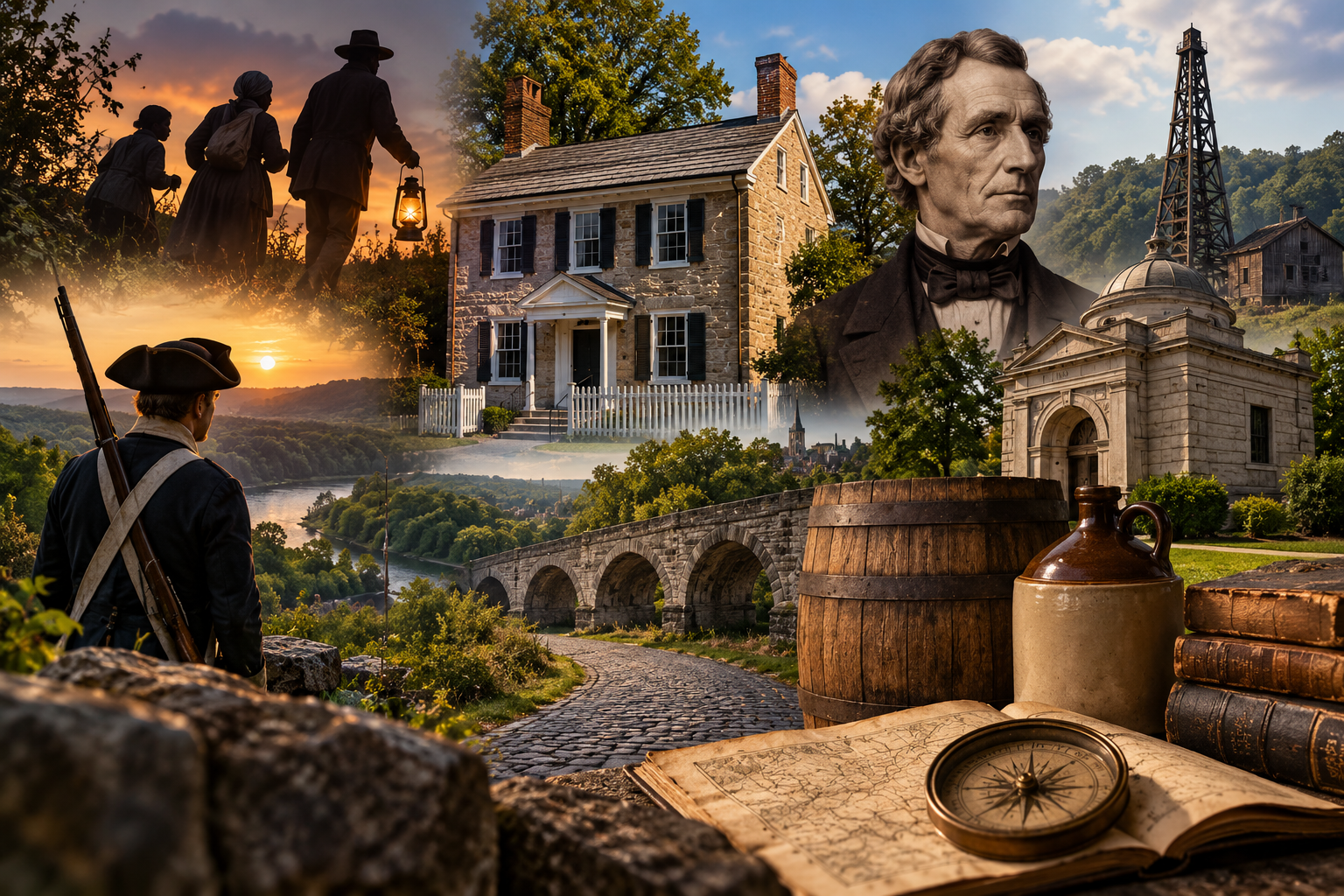
Washington County has never simply watched American history unfold—it has helped shape it. For residents, families, educators, students, researchers, and businesses, exploring historical events in Washington PA reveals how decisions made here influenced national debates about government, freedom, transportation, industry, social reform, and community life.
At the Washington County Historical Society, our mission is to preserve these connections and make them accessible through tours, events, outreach programs, and the Norma K. Grimes Research Library. Our collections and historic sites help transform local history from names and dates into meaningful stories that enrich our community, support education, encourage preservation, and open new avenues for historical and genealogical research.
From the frontier era and Whiskey Rebellion to the Underground Railroad and changing industrial economy, Washington County’s heritage offers an extraordinary window into the American experience. Let’s dive in…
Support Local History with Your Gift!
Key Takeaways
- Historical events in Washington PA connect local communities to major chapters of American history.
- The Whiskey Rebellion placed Western Pennsylvania at the center of an early federal crisis.
- Washington County’s frontier heritage predates the creation of the county itself.
- Local abolitionists contributed to the struggle against slavery and the Underground Railroad.
- Historic transportation routes helped connect Washington County with expanding national markets.
- Research collections preserve genealogy, photographs, court records, newspapers, and community stories.
- Tours and outreach programs make Washington County history accessible to residents and students.
- Preserving historic places and collections ensures future generations can explore their heritage.
Frontier Conflict Shaped The Region Before Washington County Existed
Long before Washington County was formally established in 1781, the region stood near the crossroads of Indigenous homelands, European imperial ambitions, frontier settlement, and military conflict. One important chapter involved General Edward Braddock’s 1755 expedition toward Fort Duquesne during the French and Indian War. The route associated with that campaign remains part of the larger story of Southwestern Pennsylvania’s development.
Understanding this era helps residents see that Washington County history did not begin with courthouse records or municipal boundaries. Its landscape was already connected to contests over territory, transportation, settlement, and control of the Ohio Country.
The Historical Society brings this story into public view through its “Detecting Braddock’s Road” programming, which explores efforts to locate camps associated with Braddock’s ill-fated expedition. That combination of historical research and investigation demonstrates how evidence can deepen our understanding of events that happened centuries ago.
- Explore the frontier conditions that shaped Southwestern Pennsylvania.
- Learn why Braddock’s 1755 expedition mattered to the region.
- Discover how researchers search for evidence of lost military camps.
- Connect Washington County’s landscape with the wider French and Indian War.
Washington County Was Formed During The American Revolution
The formation of Washington County in 1781 placed its institutional beginnings within the Revolutionary era. That date matters because the county developed while the new United States was still defining its political institutions, communities, and western boundaries. The history that followed would repeatedly put local residents at the center of questions with national consequences.
The Norma K. Grimes Research Library describes Washington County’s history as extending from early western-frontier settlement through the Whiskey Rebellion, National Road migration, abolitionism, social reform, and later oil and gas development. Its research resources include registered deeds and wills, newspaper collections, and Orphans’ Court records dating to 1781.
Those records give today’s researchers something invaluable: the ability to connect broad historical developments with individual people. A national event becomes more personal when you discover an ancestor’s property transaction, marriage, occupation, court record, or appearance in a local newspaper. For genealogists and community historians, Washington County’s documentary record is a bridge between family history and America’s larger story.
Historical events in Washington PA Include The Whiskey Rebellion
Few Historical events in Washington PA demonstrate the area’s national importance as clearly as the Whiskey Rebellion. After the federal government imposed an excise tax on distilled spirits in 1791, opposition became particularly intense among western farmers and distillers. Whiskey had significant economic importance on the frontier, making the tax a deeply felt political and financial issue.
Washington County became a major center of resistance. David Bradford, a prominent Washington lawyer, emerged as an influential figure in the uprising. The conflict ultimately prompted a federal response and became an early demonstration of the new national government’s determination to enforce federal law. The episode raised enduring questions about taxation, political protest, regional interests, and federal authority.
For local residents, the Whiskey Rebellion is much more than a chapter in a textbook. It unfolded across recognizable communities and landscapes in Southwestern Pennsylvania. Through historical programming, research, interpretation, and artifact study, residents can examine how an early national controversy affected people living here—and why Washington County became part of a defining test for the young United States.
The National Road Helped Open A New Era Of Movement
Transportation transformed Washington County by connecting its communities to people, commerce, and opportunities beyond the region. The National Road became an important part of westward migration, helping Southwestern Pennsylvania participate in the expanding movement of travelers and goods across the young nation.
The Historical Society identifies westward migration along the National Road as one of the significant chapters represented in Washington County’s past. Understanding this transportation history provides context for the development of communities, businesses, taverns, farms, and commercial relationships.
- The road strengthened connections between established eastern communities and western settlements.
- Increased travel created opportunities for inns, merchants, craftspeople, farmers, and other local enterprises.
- Migration brought new residents, ideas, traditions, and economic relationships into the region.
- Transportation improvements helped Washington County participate in broader patterns of American expansion.
Today’s roads make movement feel ordinary, but transportation once determined which communities prospered and how quickly information traveled. Studying the National Road era encourages residents to look at familiar landscapes differently and recognize how geography influenced local economic and social development.
The Underground Railroad Connected Washington To The Fight For Freedom
The Underground Railroad represents one of the most powerful chapters of Washington County heritage. Dr. Francis Julius LeMoyne became a prominent local abolitionist and social reformer. His surviving home in Washington offers visitors a physical connection to the region’s antislavery story.
According to the Historical Society, LeMoyne opposed slavery and opened his home and properties as stops associated with the Underground Railroad. The Society also notes that the National Park Service recognizes the LeMoyne House as an Underground Railroad site and that it is the only such NPS-recognized site in Pennsylvania west of the Allegheny Mountains.
Today, the LeMoyne House is administered as a museum by the Historical Society. Visitors can explore a place connected to abolitionism while considering the risks, moral choices, and social reform movements of the nineteenth century. The Society’s Underground Railroad outreach programming extends those lessons beyond the museum by examining Washington County’s role in the broader movement.
Be Part of Preserving History — Contribute Now!
Dr. Francis LeMoyne Challenged The Social Norms Of His Era
Francis Julius LeMoyne’s legacy reaches beyond abolitionism. Born in Washington in 1798, he became a physician and reformer whose life intersected with major nineteenth-century debates about slavery, social justice, medicine, and burial practices. His willingness to challenge accepted conventions makes him one of Washington County’s most compelling historical figures.
LeMoyne advocated cremation at a time when the practice faced considerable opposition. He designed the crematory associated with his name, and the first cremation there occurred on December 6, 1876. The Historical Society reports that 42 cremations were ultimately conducted at the facility, with the final one occurring in 1901. Today, the Society administers the LeMoyne Crematory and offers opportunities to tour it.
- LeMoyne practiced medicine and became a prominent local reformer.
- His abolitionist work connected Washington County with the struggle against slavery.
- He advocated cremation despite strong social resistance to the practice.
- The LeMoyne House and Crematory preserve tangible evidence of his remarkable life.
His story reminds us that local history is often created by individuals willing to question the assumptions of their time.
Historical events in Washington PA Live Through Preserved Places
Historical events in Washington PA become easier to understand when people can stand where history happened. Historic preservation gives residents and visitors something documents alone cannot provide: a physical sense of place. Buildings, landscapes, objects, and archival collections allow us to see history as part of the community around us.
The Historical Society administers significant resources including the LeMoyne House, LeMoyne Crematory, Norma K. Grimes Research Library, and Washington County Frontier History Center. Its artifact holdings span centuries of Southwestern Pennsylvania history and include materials connected with military history, local industry, textiles, art, and everyday life.
That preservation supports education as well as tourism. A guided historical tour can introduce visitors to the LeMoyne House, Crematory, cemetery history, frontier themes, and Underground Railroad stories. For Washington County businesses and residents, these resources also contribute to a stronger sense of place. Communities with preserved stories can offer visitors something distinctive while giving residents a deeper understanding of the people who came before them.
Industry And Energy Changed Washington County Life
Washington County’s story did not stop with the frontier, rebellion, or nineteenth-century reform. Economic transformation continued as industry and energy development altered employment, settlement, transportation, and community life. The Historical Society identifies the oil and gas boom of the 1890s as another important period in the county’s development.
Industrial history matters because economic change touches nearly every part of community life. New employment opportunities can bring population growth, while transportation networks, housing, commercial districts, and family routines evolve alongside changing industries.
For researchers, this era can be explored through many types of evidence. Newspapers may reveal advertisements, accidents, labor issues, business announcements, and social events. Photographs can show changing streetscapes and workplaces. Deeds, wills, family records, and archival materials can reveal how economic development affected particular residents.
Studying these transitions also provides useful context for today’s Washington County businesses. The industries may change, but questions about growth, infrastructure, workforce, community identity, and responsible stewardship remain relevant. Local history helps us recognize that economic transformation is part of a much longer regional story.
Archives Turn Family Stories Into Documented History
Every major historical event is ultimately made up of individual experiences. Genealogical and archival research allows Washington County residents to move from broad history into the lives of ancestors, neighbors, business owners, veterans, workers, reformers, and community leaders.
The Norma K. Grimes Research Library offers public access by appointment and provides several forms of research assistance. Its resources include deeds and wills, Orphans’ Court materials dating to 1781, newspaper collections, name indexes, vertical files, photographs, and other historical resources. The Society also offers research consultations and photo or image research services.
- Trace family connections through genealogical and public records.
- Search historical newspapers for people, businesses, events, and community news.
- Explore photographs of Washington County families, buildings, towns, and events.
- Use indexes and vertical files to locate additional historical leads.
- Schedule research assistance when a family or local-history question becomes difficult.
Research can transform an inherited story into documented history. It can also reveal unexpected connections between a family’s experience and larger events such as migration, war, industrialization, or social reform.
Community Participation Keeps Washington County History Alive
Preservation is not something a historical organization accomplishes alone. It succeeds when residents, educators, students, researchers, volunteers, donors, organizations, and local businesses recognize that their shared heritage is worth protecting.
The Historical Society makes participation possible in several ways. Tours bring people into historic spaces. Educational outreach carries programs to schools, senior centers, and organizations, with topics including Braddock’s Road, the Whiskey Rebellion, the Underground Railroad, and Dr. LeMoyne. Community events create opportunities to encounter history socially, while the Research Library helps people investigate more specialized questions.
That combination of tours, events, outreach, and research is important because people connect with history differently. A child may remember an engaging presentation. A family historian may uncover an ancestor in an old record. A visitor may be moved by the LeMoyne House. A business may support an event that strengthens community identity.
Preservation turns those individual experiences into a shared commitment: keeping Washington County’s stories accessible for the people who will inherit them next.

Frequently Asked Questions About Historical events in Washington PA
Q: What are some of the most important Historical events in Washington PA?
A: Major local stories include the Whiskey Rebellion, frontier-era conflict, National Road migration, the Underground Railroad, nineteenth-century social reform, and later industrial and energy development.
Q: Why was the Whiskey Rebellion important to Washington, PA?
A: Washington County became a major center of resistance to the federal whiskey excise tax. The confrontation helped test the new federal government’s authority and placed Western Pennsylvania in a nationally significant political dispute.
Q: Where can I learn about Historical events in Washington PA in person?
A: Start with the Washington County Historical Society. Its tours and historic resources include the LeMoyne House, LeMoyne Crematory, Research Library, and programming covering major regional stories.
Q: Are Washington County Historical Society sites and programs accessible to groups?
A: The Society offers tours, outreach presentations, educational opportunities, and group programming. Because individual sites and programs differ, contact WCHS when scheduling to discuss your group’s specific accessibility needs.
Q: How much does historical research cost?
A: The Research Library currently lists free library admission for WCHS members and $7 daily admission for non-members. Separate research services and consultations have their own fees, with member discounts available. Check current pricing before visiting.
Q: Can Washington County Historical Society help with genealogy?
A: Yes. Research services draw on sources including deeds, wills, Orphans’ Court records, newspapers, indexes, vertical files, and other Washington County resources. Research requests are submitted through the Society’s online forms.
Q: Does the Historical Society offer programs outside its museums?
A: Yes. Educational outreach programs are available for Washington County senior centers, schools, and organizations, covering subjects such as the Underground Railroad, Whiskey Rebellion, Braddock’s Road, and Dr. Francis Julius LeMoyne.
Q: How can local businesses participate in preserving Washington County history?
A: Businesses can attend and promote programs, encourage employees to participate, support preservation initiatives, collaborate on community activities, and donate to help sustain historical collections, education, research, and public access.
Q: What impact does donating to local history preservation have?
A: Donations help historical organizations care for buildings, artifacts, photographs, documents, educational programs, and research resources. That support helps keep Washington County’s heritage available to residents, students, researchers, and future generations.
Q: What are the benefits of learning about Historical events in Washington PA?
A: Local history strengthens community identity, adds context to national history, supports education and heritage tourism, and helps residents understand how earlier generations shaped the places where they live and work today.
The story of Historical events in Washington PA is ultimately the story of people confronting change—from frontier conflict and political rebellion to abolition, transportation, social reform, industry, and preservation. Each chapter helps Washington County residents and businesses understand why this community developed as it did and why protecting its historic resources matters.
Under the leadership of Executive Director Clay Kilgore, the Washington County Historical Society works to make that history discoverable through tours, events, outreach, collections, and research. Whether you want to walk through a historic site, investigate your family tree, introduce students to local heritage, or simply understand your hometown better, there is another piece of Washington County’s story waiting to be explored.
Ready to be a part of history preservation? Help ensure the places, documents, artifacts, and stories that define our community remain available for future generations.